.png?width=4041&height=907&name=Spinnaker%20SCA%2c%20A%20Company%20of%20Publicis%20Sapient%20(Light).png)


The most dangerous legacy problem is not using old software. It’s making long-term decisions based on short-term thinking.
Supply chain technology rarely fails in a cinematic way. Usually, these systems hang around long enough for people to become familiar. Long enough for core users to build workarounds that solve known limitations. And just long enough that business leaders stop asking “Could we...?” and join in the chorus of “That won’t work.”
The software still runs, technically. Orders move. Inventory ships. Operators make it through another day.
However, performance starts to deteriorate. Plan accuracy is often suspect and debated. Every process script has a dozen appendages hanging off it. And there are scores of integrations that nobody wants to touch because the person who built it left five years ago and one change may cause the whole thing to come crashing down.
The truth is that an environment like this is not stable. In fact, it’s costing you more than you realize. Not just maintenance dollars. But speed. Agility. Decision confidence. The ability to make a small change without it turning into a potential catastrophe. You’ve accrued technical debt.
If you’re like a lot of our clients that are looking to modernize their supply chain, then you know that accessible, composable technology is a part of the solution. But it is just one part.
How we got here—more software, more problems
Most enterprise solution architectures and supply chain technology ecosystems were built by smart people that were forced to solve complex problems in real-time leveraging a limited set of tools and expertise.
For a long time, on-premises solutions made sense. Especially for those that wanted to maintain their own environments, their own release timing, their own support cadence, and ultimately their own sense of control. Plus, when the solution no longer fit, you could change it. Customize it. Or build around it.
Unfortunately, this onslaught of custom enhancements, bolt-on interfaces, one-off modifications, homegrown reports, shadow logic, and all the other scaffolding that keeps a platform standing long after the original architecture stopped being elegant.
Because end user expectations and economic headwinds move faster than any traditional software development lifecycle (SDLC), companies are often left with a crumbling foundation of ineffective digital ruin. And they start to wonder if there’s a better way.
The real challenge of legacy modernization
Companies currently working to upgrade their supply chain technology solutions are not only caught in the AI hype cycle but mired in the quagmire of their own technical debt.
While every technology provider creates the inevitable fear of missing out on their latest technology story, offering "frictionless upgrades" that enable "proven ROI," technical debt has become the biggest inhibitor value realization and continuous improvement.
It’s also why the on-premises versus SaaS debate is too small. This isn’t a hosting decision. A “lift and shift” to a SaaS environment will not magically turn your legacy supply chain into a modern one.
What matters is whether your data, technical foundation, and operating discipline can support where your business is going. Moving platforms doesn’t fix weak foundations—it exposes them.
Getting started with cloud migration
If you’re modernizing a legacy supply chain platform, don’t treat it like a simple upgrade. Instead, approach it as a full technology refresh.
Because you are not just changing where the system runs. You are changing system architecture, data governance, process ownership, support structures, release cadences, testing rigor, how integrations are built and maintained, and user enablement.
In our work with supply chain and IT leaders, here’s the pre-work we typically do ahead of a cloud migration:
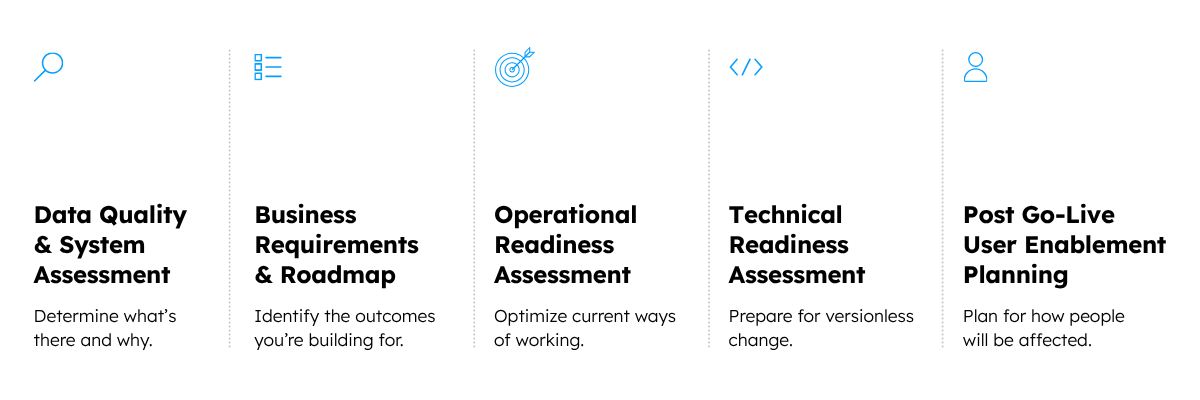
1. Data Quality & System Assessment
Before you do anything else, stop and review how your data and system(s) actually work today. Determine what’s there and why it’s there.
In this end-to-end audit, be sure to identify owners, sequencing rules and interdependencies across master data, integrations and system configuration. Take an inventory of all the business logic and database shortcuts as well as “exceptions” that have become routine.
From there, you’ll be able to decide what to clean, what to enhance, what to retire, and what to migrate. (Note: Modernization platforms like Sapient Slingshot can halve the time it takes to do this upfront assessment work.)
2. Business Requirements Definition & Migration Blueprint
Identify the outcomes you’re building for. Go beyond how you’re operating today and figure out what you need to build what’s next.
Based on your starting point, you can then create an informed, prioritized roadmap for how to get there. However, be sure to separate true requirements from bad operational habits. If you carry everything forward, you’re not modernizing—you’re just relocating complexity.
3. Operational Readiness Assessment
Technology should enable a process—not the other way around. This is your chance to optimize current ways of working. From IBP to inventory management and facility design, challenge and fix what isn’t working before you get too far down the system migration path.
4. Technical Readiness Assessment
SaaS enforces a different level of technical discipline. Ready or not, there will be either fixed or semi-fixed release cycles. You will need stronger performance testing, benchmarking and validation. Plans for outage scenarios and recovery processes. Plus, role-based access and tighter security protocols.
5. Post Go-Live User Enablement Planning
The success of a digital transformation hinges on whether people use it and if it improves the way work is being done. So, before you even begin—and throughout the entire migration process—consider how the people in your organization will be affected and how you will train and re-enable users. Plus, determine which KPIs, policies and incentives will need to be adjusted as a result. None of this should be an afterthought.
Migrate to the cloud for the right reasons
Legacy systems don’t just cost money. They limit what your business can do. But migrating platforms without gaining capabilities and clarity just relocates your problem. The goal isn’t speed—it’s alignment between your technology ecosystem and the direction your business is headed in.
That’s where an outside perspective can be helpful. Spinnaker SCA is not here to push a particular platform, but to help expose what’s real and what actually needs to change. Because the most dangerous position isn’t legacy itself—it’s protecting it.
So, you should be suspicious when you’re being influenced to make long-term decisions with short-term logic. “Move to SaaS. Simplify your stack. Get AI-ready. Don’t get left behind.”
Supply chain modernization decisions should be made in the context of your company’s business strategy, North Star and target operating model—not based on the loudest voice on the trade show floor.