

Not all supply chain failures are obvious. Nor do they start with a newsworthy disruption like a port strike. There’s oftentimes a quieter and more insidious culprit: strategic drift.
Operational cost structures change and impact production output. Customer expectations heighten and cause unexpected demand. New products proliferate and create sales channel confusion.
Without a solid target operating model, your supply chain processes and systems are likely stuck looking in the rearview mirror while your business priorities have changed lanes.
This disconnect usually shows up in your day-to-day operations well before you see it on a dashboard or financial statement. Production timelines slip. Customer orders are expedited. Inventory is discounted in one region, while there are out of stocks in another. Decisions made in functional siloes inadvertently ripple across your entire supply chain.
If it feels like your team is like a dog chasing its own tail, it may be time to revisit your supply chain strategy and target operating model. In today’s economy, a strategy refresh cannot be confined to an annual cycle. Especially if you’re operating within an increasingly competitive and consumer-driven industry like retail, consumer products or high-tech.
Defining a supply chain strategy
Before I continue on, let’s quickly define some terms. As you will see, a well-defined strategy is like a pyramid. It’s layered and hierarchical. Each tier is derived from the one above it.
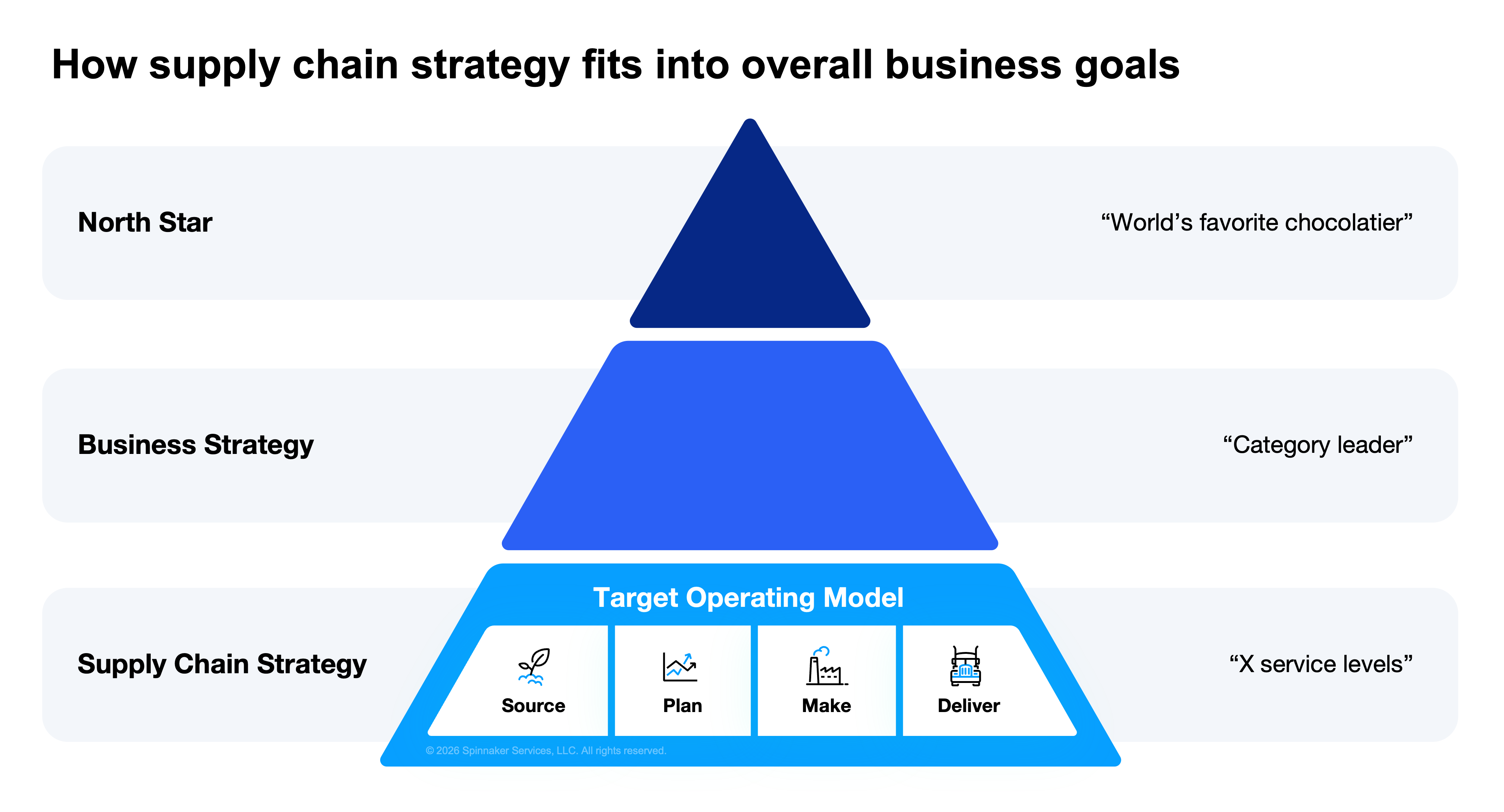
- North Star: This is your corporate mission and vision. It’s the identity your company is striving for like “world’s favorite chocolatier.”
- Business Strategy: Your business strategy translates your North Star into tangible achievements like “category leader” and “shareholder profits.”
- Supply Chain Strategy: Your supply chain strategy takes your business strategy one step further. It’s the practical achievements you must hit day in and day out like “X service levels” and “Y margins” that will contribute and add up to your overall business goals.
- Target Operating Model: Sitting inside your supply chain strategy, your target operating model is the framework that lays out how your supply chain team will collaborate and make decisions both within the team and across the company to source, plan, make and deliver products.
To be clear, a large enterprise generally has one global operating framework and several operating model variations that align to specific geographies, business units or supply chain processes (e.g., supply chain planning)—each one tied back to the overall global framework. Collectively, they enable the overarching supply chain strategy.
How to build a target operating model
At Spinnaker SCA, we apply our Five Lenses Framework consisting of people, process, technology, policies and metrics to build and assess target operating models.
Think of a target operating model as a wheel with the Five Lenses—people, process, technology, policies and metrics—as the spokes. As you can imagine, if even one spoke has a crack or is generally out of alignment, the whole thing wobbles.
To help you reflect on your company’s target operating model and identify the source(s) of any instability, let’s break down each component.
- People. This refers to more than just headcount. Do we have the right organizational design, skills and capabilities to operate your supply chain? Are roles and responsibilities defined, understood and agreed upon? Are team members properly trained and empowered to drive continuous improvement?
- Process. This is where your supply chain strategy is systemized. Ask yourselves: Are processes clearly architected and aligned with business goals and metrics? Are business rules and decision responsibilities clearly defined? Are our processes scalable and flexible to meet evolving business needs, or have we built workarounds that collapse under volume or unforeseen disruptions?
- Technology. Enabling technology is a tool, not the destination. It should tie people and processes together, so decisions are made effectively, efficiently and with agility. Do our tools enable effective supply chain decision-making, or just reporting? Are they configured with the process in mind, or based only on what the tool can do? Is our data standardized? Accessible? Will our tech stack hold up in the messy day-to-day well after go-live?
- Policies. Policies are not bureaucracy, rather they are guardrails for decision rights. They let the organization act without fear of retribution when there isn’t a “right” call. Are our core business practices and rules consistent with your supply chain performance objectives? Do policies align with the promises we make to customers and to the people asked to keep those promises? Is our team empowered to make the decisions they need to operate with efficiency, not red tape?
- Metrics. This is the feedback loop that keeps you honest. Yes, what gets measured gets done, but the bigger point is that metrics reveal tradeoffs. What are our target KPIs, and are they realistic and achievable? Which results will indicate success? Are metrics across organizational boundaries in conflict, forcing teams to “win” locally while the enterprise loses? How do we monitor operational health in real time?
You will know if your supply chain target operating model is working when it consistently produces two outcomes: availability and agility.
Availability refers the classic supply chain idiom of getting the right product, in the right place, at the right time. Agility, on the other hand, represents what you can do when things don’t go right. Can you respond without the entire wheel flying off?
The simplest tests are still the most honest: Has supply met demand? Are customers happy? Is revenue growing? If you see a degradation in sales, market share or customer satisfaction that traces back to operational friction, you likely have a cracked spoke or two in your target operating model.
With all of this in mind, I’m sure you’ll agree that AI should not be haphazardly turning your business strategy upside down. The top of the strategy pyramid is fairly rigid and unmoving. However, what may change—and the area that is ripe for AI-enabled innovation—is how you bring your supply chain strategy to life and the ways in which you execute your target operating model.
(Related: If your company’s AI pilots are unscalable or delivering lackluster value, check out this article from my colleague George Fowler which outlines five technology must-haves that create the foundation for AI-enabled innovation.)
Choosing the right place to start
As you start to evaluate the efficacy of your target operating model(s), be sure you have a well-defined scope. In my work with large enterprise clients, I usually see one or more of the following target operating model definitions:
- Geography: For companies with global operations as well as those serving a global customer base where SKUs or products are somewhat segmented, geography tends to be a good common denominator. In this case, you might have a North American Target Operating Model, EMEA Target Operating Model, and so on.
- Business Unit: If your supply chain is more global in nature or there is a fair amount of vertical integration, a BU-level definition with some level of shared services may be the most practical starting point.
- Process: Depending on the breadth of your business across manufacturing, distribution and retail, a more process-oriented scope may be most useful. Think Procurement, Manufacturing, Planning, Operations, and Customer Experience.
This exercise is helpful because the scope of your target operating model determines the “degrees of freedom” for any potential improvements. For example, are you taking a true greenfield approach, or working within the constraints of existing CapEx investments? Another way to think about it: are you using a pure strategic lens, or staying with what's feasible?
The cost of doing nothing
In a recent survey, 63% of manufacturing CEOs said supply chain challenges are hindering their ability to innovate at scale. However, in that same survey, only 18% of CEOs reported considering major network reconfigurations because of these disruptions. Why? It’s costly and time-consuming to physically rearchitect a global supply chain.
However, with a supply chain strategy aligned to your business strategy and a well-defined target operating model you can still sense and respond to changes across your network in near real-time—and you must if you want to stay competitive.
Hitting refresh on your target operating model
If you’ve gotten to this point and you recognize that your supply chain strategy and target operating model need a refresh, then let me impart one final piece of advice: Objectivity beats blind optimism.
Every company’s biggest blind spot is homegrown. Not because people aren’t good at their jobs, but because incentives collide. Sales wants growth. Operations wants efficiency. Finance wants liquidity. Engineering wants innovation. It’s why strategy work often benefits from a neutral third-party like Spinnaker SCA.
We help companies clarify their North Star, translate it into a business and supply chain strategy, and build a target operating model that helps you make decisions faster, smarter and more consistently. We bring an unbiased view along with pattern recognition from hundreds of similar engagements. We know what works, what will fail, and what looks good on paper but don’t hold up to operational realties.
If you’re ready to stop chasing your tail and start running the race, let's talk.