

How planning organizations should change when implementing an Advanced Supply Chain Planning System
Supply chain planning transformation changes more than your technology. A typical question from client executives embarking on a planning transformation is how their organizational design and capabilities need to evolve to be successful with the new solutions.
Organizations that achieve the greatest business value recognize that modern planning systems automate plan generation and transactional activities, allowing planning teams to shift their focus toward exception management, scenario analysis, governance, and strategic decision-making. As planning processes become increasingly integrated and AI-enabled, success depends as much on organizational design, data governance, decision rights, and process discipline as it does on the planning technology itself.
Subsequently, the planning organization needs to transform to manage new policies and how they translate into solutions and processes.
The organizations that realize the most value make a fundamental shift in how they plan from:
Building the planning organizational capabilities to drive best-in-class planning outcomes
First things first, ensure processes are defined across S&OP and S&OE horizons
While the focus of this article is organizational design, process definition across Sales & Operations Planning (S&OP) and Sales & Operations Execution (S&OE) is the key starting point for a supply chain planning transformation.
Supply chain planning platforms deliver value best when supported by a structured process that focuses on key decisions for the organization and aligns decisions across strategic, tactical, and operational horizons. S&OP and S&OE provide the forums, decision rights, and escalation paths needed to translate planning insights into coordinated actions around demand, supply, inventory, capacity, allocation, and customer commitments. Before launching into organizational design, having a clear framework for how decisions get made across these horizons is a key first step.
Establishing a Planning Center of Excellence (CoE)
The Planning Center of Excellence (CoE) is there to keep planning processes, data, technology, and decision policies consistent across the enterprise as the organization adopts advanced supply chain planning platforms. It brings together the governance, expertise, and continuous improvement needed to maximize the platform’s value and support scalable, data-driven, increasingly AI-enabled decision making. The organization typically lives in the business versus IT but partners closely with IT subject matter experts on the solution design. This organization becomes the "brain" of the planning ecosystem.
A mature CoE typically owns:
Building Supply Chain Planning Data Governance
Supply chain planning data governance is the foundation of any successful supply chain planning transformation because planning decisions are only as good as the data that drives them. Establishing clear ownership, stewardship, quality standards, and governance processes ensures that the planning platform operates from a trusted source of truth and prevents the organization from reverting to spreadsheet-based decision making.
While enterprise data governance establishes company-wide policies and controls for managing data assets, supply chain planning data governance ensures that the specific data required to generate accurate and executable plans is properly owned, maintained, governed, and provided to the SCP systems so that they can generate accurate plans.
The supply chain planning data governance function typically sits within the Planning CoE. Without supply chain planning data governance, the planning system becomes an expensive spreadsheet.
Example ownership structure
| DATA DOMAIN | BUSINESS OWNER |
| Products | Product management |
| BOMs | Engineering |
| Routings & Capacity | Manufacturing |
| Lead Times | Supply Chains |
| Inventory Policy | Planning |
| Customer Hierarchies | Commercial |
| Demand History | Demand Planning |
| Sourcing Rules | Supply Planning |
| Order Priorities | Customer Operations |
Required Governance
-
Data quality metrics
-
Data stewardship roles
-
Master data workflow approval
-
Data audit process
-
Exception management process
- Data certification process
Future-State Organizational Structure
An operating model for supply chain planning brings people, processes, data, and technology into a consistent framework. That does not mean every part of the business needs the same operating strategy. Different strategies may be appropriate, provided they are coordinated within a framework that is consistent across the organization as it moves to advanced planning.
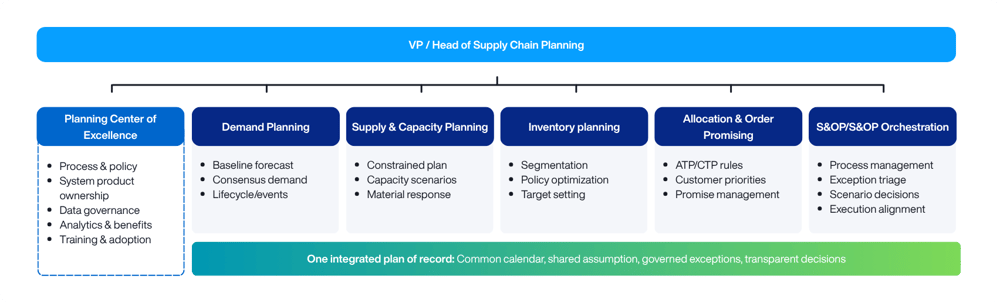
The future-state structure often centralizes planning governance at the corporate or business unit level while creating specialized roles that improve cross-functional coordination, accelerate response to supply chain disruptions, and enable scalable adoption of AI-driven planning capabilities.
A typical centralized supply chain planning organization is outlined below:
How supply chain planner roles change
For planners, the shift from maintaining plans (i.e. planning “outputs”) to helping ensure the “inputs” to the advanced planning models are correct is significant. Advanced planning systems automate data collection, plan generation, and routine transactional activities. That leaves planners spending less time maintaining plans and more time ensuring inputs are correct, analyzing scenarios, managing exceptions, resolving constraints, and supporting decisions that improve supply chain performance. The activities and time allocations below show how that shift changes the role.
New roles that don't exist today
As planning becomes more automated and integrated, supply chain planning roles and responsibilities need to make clear who governs the technology, data, analytics, and decision policies. The transition to a CoE model means more central personnel helping design and manage the processes and systems but the incremental headcount is typically offset by fewer hands-on planners. The CoE's capabilities sustain the platform’s value, drive continuous improvement, and keep planning decisions aligned with business objectives as the organization advances toward AI-enabled planning.
The following roles are often new to an organization:

Planning Product Owner owns (Business Role):
- Planning roadmap
- User requirements
- Prioritization
- Vendor relationship
- IT coordination
Supply Chain Data Governance Lead owns:
- Master data quality
- Data stewardship
- Governance forums
Supply Chain Analytics Lead owns:
- KPI framework
- Reporting
- AI model monitoring
Allocation Manager owns (often a role within the order management team):
- Allocation strategies
- ATP/CTP rules
- Customer prioritization policies
Rebalancing Supply Chain Planning Skillsets
As organizations go through a planning transformation, the makeup of the planning organization typically migrates from a large number of “hands on” planners across the different planning processes to fewer hands-on planners but more IT and CoE support to ensure the planning system is operating correctly and drive continuous improvement. A representative example of headcount changes in the different planning functions is outlined below.
| AREA | CURRENT | FUTURE |
| Demand Planning | 50 planners | 20-30 planners |
| Supply Planning | 75 planners | 30-45 planners |
| Allocation Teams | 25 coordinators | 5-10 specialists |
| Planning Systems Support | 5 | 5-10 |
| Planning CoE | 0 | 5-10 |
| Analytics | 2 | 4 |
The net result is often a 30-60% reduction in transactional planning effort, but an increase in:
-
Business Analysts
-
Scenario Planners
-
IBP coordinators
-
Planning System SMEs
- Data Governance Roles
An organizational rethink, not just a technology upgrade
The shift to advanced planning is not simply about generating plans faster. It is about changing how the organization makes decisions.
Clear decision rights, trusted data, cross-functional governance, and a Planning CoE give planners the foundation to spend less time maintaining spreadsheets and more time evaluating scenarios, resolving constraints, and supporting business decisions.
As planning becomes increasingly AI-enabled, that organizational responsibility grows. The CoE’s role expands beyond governing planning processes and technology to overseeing algorithms, data quality, decision policies, and AI agent behavior.
Automated plan generation does not remove the need for ownership and accountability; it changes where they matter most.