


The warehouse automation conversation has changed.
A decade ago, organizations primarily asked whether automation could reduce labor costs. Today, they are asking a more complex question: How do we design operations that maximize the strengths of both people and machines?
The most successful warehouse transformations are no longer pursuing fully automated "lights-out" facilities as the default end state. Instead, leading organizations are designing human-centric automated operations where robotics, software, and AI augment people, rather than simply replace them. Automation decisions should start with operational constraints, material flow realities, and business outcomes rather than technology selection alone. The Operator’s Guide to Warehouse Automation highlights the importance of matching automation approaches to each customer’s unique product characteristics, order profiles, and operational requirements rather than assuming one-size-fits-all solutions.
The goal is not to choose between humans and robots, but to connect automation, AI-enabled real-time decision intelligence, and people into one adaptive operating model. Automation executes routine work; intelligence coordinates responses to changing conditions; and people provide judgment, resolve exceptions, and guide improvement. Matching each activity to the resource best suited to it enables agility, resilience, and scaling over time as demand, product mixes, and business priorities evolve. Autonomy does not replace people—it shifts their contribution toward higher levels of business performance.
The Myth of Full Automation
Warehouse executives are often captivated by sweeping automation success stories featuring robotic storage systems, autonomous mobile robots (AMRs), automated storage and retrieval systems (AS/RS), and advanced sortation technologies.
While these technologies can deliver significant benefits, many organizations discover that maximum automation does not always equal maximum warehouse operational performance. The problem is that today’s supply chains are rarely stable. Product mixes change. Customer expectations evolve. New channels emerge. Acquisitions occur. Demand spikes unexpectedly. Humans excel in environments characterized by variability, ambiguity, and judgment. Robots excel in environments characterized by consistency, repetition, and precision.
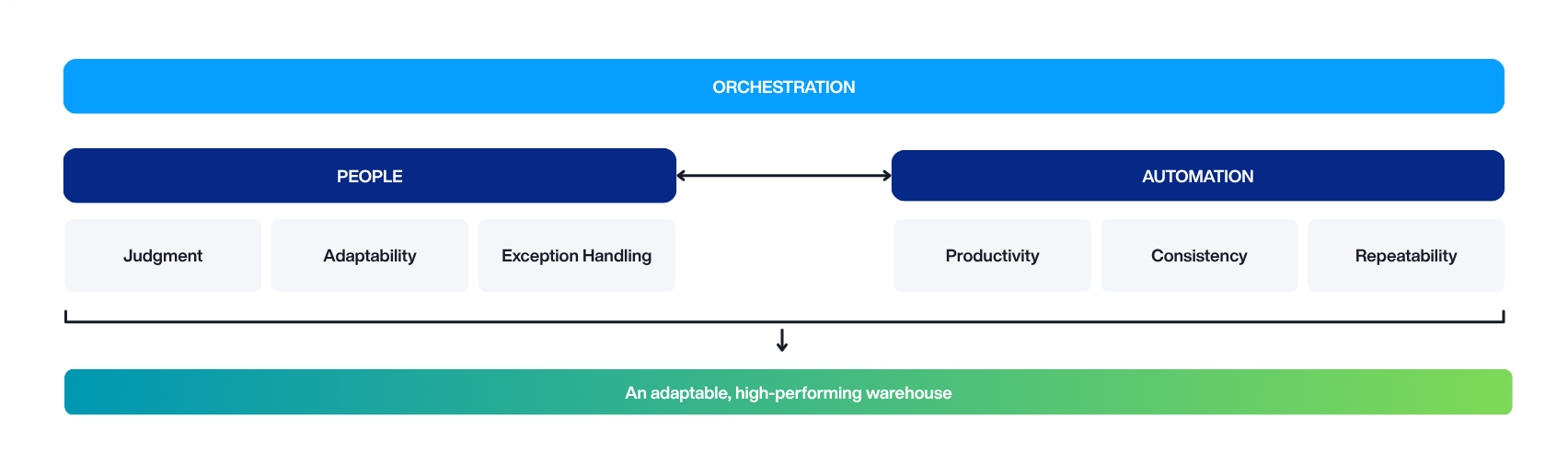
Organizations that automate every process without understanding where flexibility is required often create highly efficient systems that struggle to adapt. Conversely, organizations that rely too heavily on manual labor may achieve flexibility but sacrifice productivity, quality, and scalability. The optimal warehouse is typically neither fully manual nor fully automated. It is a carefully orchestrated ecosystem where both operate together.
Understanding Human Strengths and When to Prioritize Them
Before deciding what to automate, leaders should understand the capabilities that their people bring to warehouse operations.
Adaptability: Warehouse associates can immediately react to unexpected situations like: Damaged inventory, Short shipments, Product substitutions, Equipment failures and shifting Customer-specific exceptions. While AI and automation continue to advance, humans remain superior at managing situations where business context matters.
Problem Solving: Experienced operators often recognize operational issues before systems identify them. They understand patterns, bottlenecks, and practical workarounds that may not be visible in dashboards or control towers.
Continuous Improvement: The best improvement ideas frequently originate from frontline workers who interact with processes daily. Organizations that automate aggressively without involving operators often lose valuable institutional knowledge.
Customer-Centric Decision Making: Certain fulfillment decisions require balancing competing priorities such as service levels, profitability, inventory constraints, or transportation considerations. Human judgment remains important in these situations.
When to Optimize for Humans
Organizations should lean toward human-centered designs when:
In these environments, wearable technologies, voice-directed picking, AI-assisted decision support, and productivity tools may create more value than extensive robotics investments.
Understanding Robot Strengths and When to Prioritize Them
If humans provide adaptability and judgment, automation delivers capabilities that people simply cannot match at scale.
Consistency: Robots execute tasks identically every time. This generally results in: Reduced defects, Improved inventory accuracy, Higher throughput consistency and Lower dependency on the effectiveness of staff training programs
Throughput: Modern robotic systems can often process significantly higher volumes than manual operations, particularly in repetitive tasks such as sortation, storage, and retrieval.
Warehouse automation assessment work across multiple industries frequently shows that productivity improvements often come less from eliminating people and more from removing wasted travel time and non-value-added activities. Technologies such as goods-to-person systems, AMRs, and automated material flow solutions are specifically designed to reduce unnecessary movement while improving worker productivity.
Availability: Machines do not experience fatigue or turnover. They support extended operating hours and can help organizations manage increasingly difficult labor markets.
Precision: Robotics excel in high-accuracy warehouse / fulfillment operations including tasks like: Piece picking, Sortation, Pallet movement, Inventory verification and even areas like Quality inspection
Computer vision, robotics, RFID, and automated verification technologies continue to expand the range of processes that can benefit from machine precision.
When to Optimize for Robots
Organizations should pursue greater automation when:
The Rise of the Hybrid Warehouse
Experience shows, that many of the most successful modern warehouse facilities increasingly adopt hybrid operating models. People provide judgment, robots execute routine tasks, and AI helps coordinate their work as conditions change.
Examples include:
| FUNCTION | HUMAN ROLE | AUTOMATION ROLE |
| Receiving | Exception handling | Automated identification and verification |
| Storage | Inventory management | AS/RS and robotic transport |
| Picking | Complex exceptions | Goods-to-person automation |
| Replenishment | Oversight and adjustments | AMRs and automated movement |
| Quality | Root-cause analysis | Vision inspection systems |
| Planning | Exception management | AI-generated recommendations |
This model allows organizations to achieve productivity gains while retaining business flexibility. The growing adoption of warehouse operational agents and AI-enabled orchestration reflects this trend. Rather than replacing operators, emerging systems increasingly monitor operations, predict workload changes, and provide recommendations that humans can evaluate and approve.
Five Principles for Balanced Automation
1. Solve the Constraint, Not the Technology Problem
Many organizations begin with a preferred automation technology. The better approach is to identify the operational constraint first. At Spinnaker SCA, this means starting with the client’s growth objectives, service requirements, labor challenges, and facility constraints—not a preferred technology.
Ask:
- Is labor availability the issue?
-
Is storage density the issue?
-
Is throughput the issue?
-
Is accuracy the issue?
-
Is scalability the issue
Only then should technology selection begin.
2. Design Around Material Flow
Automation performs best when aligned to end-to-end flow rather than isolated tasks. Material should move predictably and efficiently through the facility regardless of which technologies are deployed.
3. Prioritize Modularity
Technology decisions made today should not limit future options. AMRs, flexible storage systems, and cloud-based orchestration platforms often provide greater long-term adaptability than highly fixed solutions.
4. Keep Humans in the Loop
Automation should inform human decisions whenever risks, exceptions, or tradeoffs exist. People should manage judgment-intensive processes while machines handle routine execution.
5. Treat Technology as an Ecosystem
Automation success depends on the interaction between: WMS, WES, WCS, Robotics, Material handling systems, Analytics platforms, and AI orchestration layers.
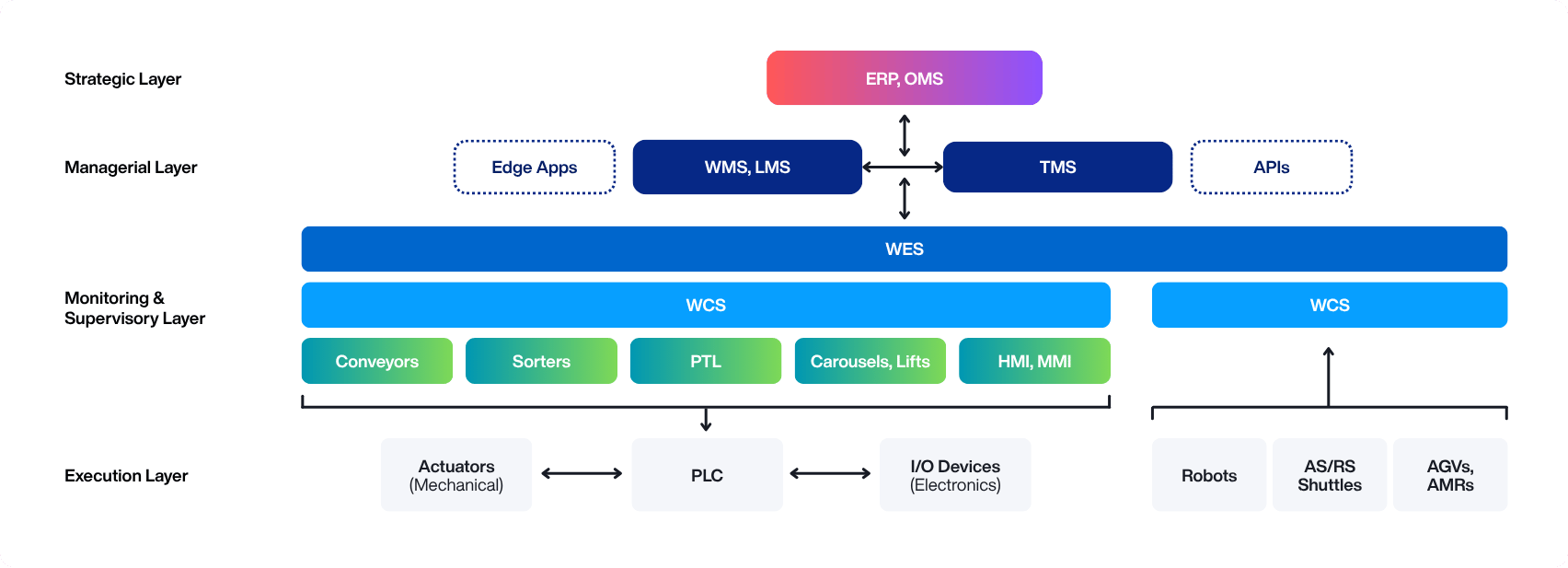
Modernization efforts increasingly require organizations to evaluate what functionality belongs in each layer rather than simply adding more automation. This architectural discipline becomes even more important as AI and robotics capabilities expand.
Conclusion
The future warehouse will not be defined by humans or robots, rather it will be defined by organizations that intelligently combine both. Humans bring judgment, creativity, adaptability, and problem-solving. Robots bring speed, precision, consistency, and scalability. AI increasingly serves as the coordination layer that enables both to work together more effectively. Warehouse leaders who focus exclusively on labor elimination risk building inflexible operations. Leaders who ignore the powers of appropriate automation risk falling behind competitors in efficiency and service performance. The winning strategy is not automation for automation's sake. It is designing a warehouse where every activity is performed by the resource best suited for the job.
In the end, warehouse excellence is not a technology decision. It is an operating model decision. The organizations that thrive will be those that optimize for humans and robots simultaneously, creating supply chains that are not only more productive, but also more resilient, scalable, and prepared for whatever comes next.
Wondering where automation could help—and where human flexibility matters most? Whether you’re exploring your first investment or rethinking how people, robots, and AI work together, I’d love to help you think it through. Let’s have a conversation about the right balance for your warehouse and how Spinnaker SCA might be able to help.