



Healthcare supply chain planning has traditionally been addressed in functional silos: materials teams plan supplies, operations teams plan beds, workforce leaders plan labor, and clinical engineering or finance teams plan capital equipment.
While each area is important, the lack of an integrated planning model creates blind spots for hospital systems. A hospital may have enough beds but not enough nurses; sufficient staff but inadequate personal protective equipment; or available imaging equipment in one location while patients wait elsewhere. The result is a fragmented planning environment that struggles to balance cost, service, capacity, and patient outcomes across the full network.
Healthcare planning requires a holistic planning engine built around four interdependent planning areas: hospital supplies, hospital bed utilization, labor, and capital equipment. These areas should be driven by a single demand forecast and connected through an integrated supply planning model that allows hospital systems to optimize the network rather than make isolated facility-level decisions.
Why Healthcare Needs a Holistic, Connected Planning Model
Healthcare is one of the most operationally complex industries in the world because demand is uncertain, service requirements are immediate, and capacity decisions can directly affect patient care. Public health emergencies have shown that hospitals can face simultaneous shortages of PPE, staff, supplies, beds, and space, with planning gaps becoming most visible during crisis conditions. Guidance from public health and healthcare quality organizations emphasizes the need to plan for surge demand, resource conservation, and contingency operations before systems become overwhelmed.
Despite this need, many planning solutions still focus on one domain at a time. Inventory systems may optimize stock levels, workforce tools may schedule clinicians, and bed management systems may track census and discharge timing. However, these systems often do not share a common forecast, common capacity assumptions, or common scenario logic. A holistic model would connect these planning decisions so leaders can understand trade-offs, identify constraints earlier, and rebalance resources across hospitals, departments, and service lines.
The Framework: Four Planning Areas Driven by One Forecast
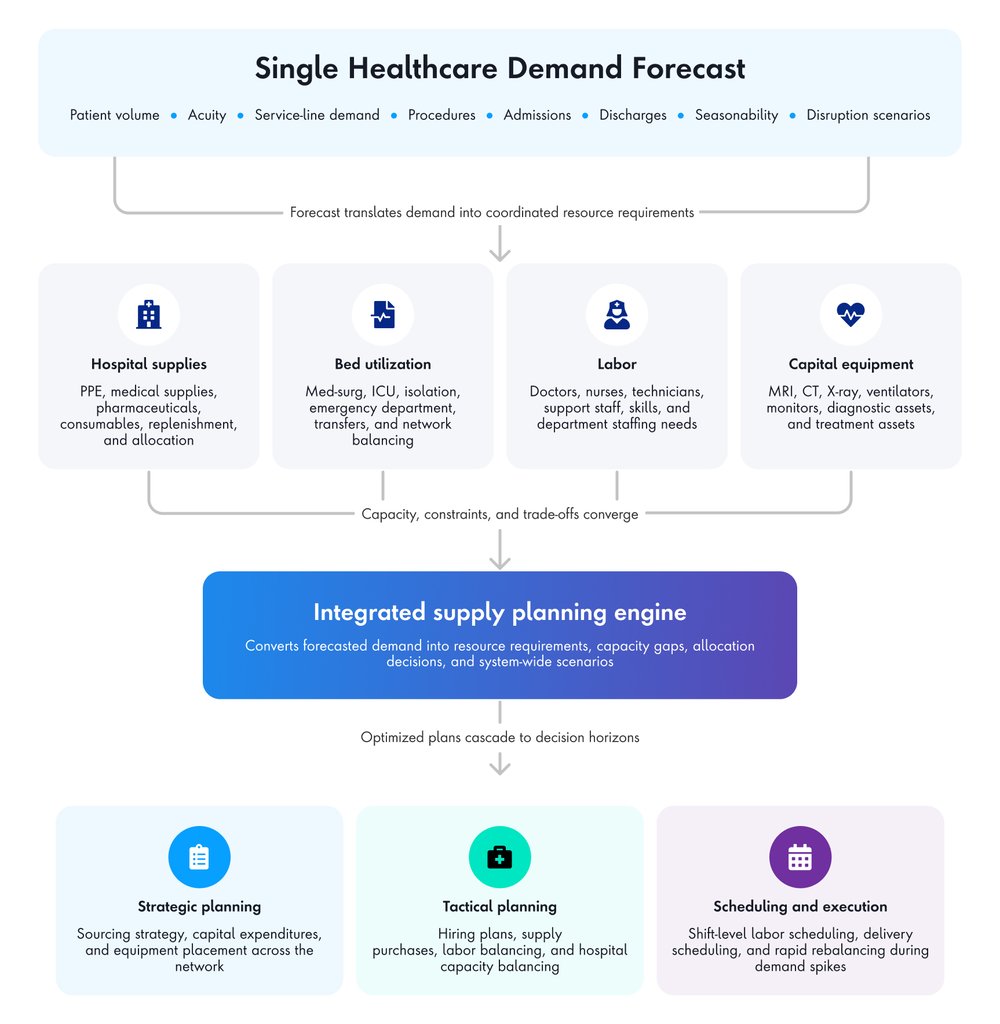
The Single Forecast as the Foundation
A holistic healthcare planning model begins with a single demand forecast. This forecast should translate expected patient demand into operational requirements across the network. It should incorporate historical volumes, scheduled procedures, seasonal illness patterns, emergency department trends, admission and discharge expectations, service-line mix, patient acuity, and external signals such as outbreaks, weather events, or regional disruptions.
The single forecast matters because every downstream planning decision is connected. A projected increase in respiratory patients may drive higher PPE consumption, greater need for ICU beds, increased respiratory therapist coverage, and higher utilization of ventilators and imaging equipment. If each function uses a different forecast, the system may over-invest in one area while under-preparing in another. A shared forecast creates alignment, allows leaders to evaluate trade-offs, and provides a common language for clinical, operational, supply chain, workforce, and finance teams.
The Integrated Supply Planning Model
Once the demand forecast is established, the supply planning model converts demand into specific resource requirements. The model should identify capacity gaps, recommend allocation decisions, and support what-if scenarios across the hospital network. It should not simply answer whether an individual hospital has enough capacity; it should determine how the entire system can serve demand by balancing resources across locations.
1. Hospital Supplies Planning
The hospital supplies planning layer determines what materials need to be purchased, replenished, staged, and allocated across the health system. This includes PPE, medical-surgical supplies, pharmaceuticals, consumables, lab materials, and other clinical items required to support patient care. The model should translate forecasted patient volume and acuity into item-level demand by facility, department, and time period.
At the network level, the planning engine should recommend replenishment quantities for central warehouses and forward stocking locations. It should also determine how supplies are distributed to individual hospitals based on projected demand, current inventory, service priorities, lead times, supplier constraints, and emergency stock policies. During normal operations, this improves service levels and reduces waste. During surge conditions, it helps leaders understand where shortages will emerge first and how limited inventory should be allocated across the network.
Hospital supplies planning must also account for regulatory and compliance requirements, particularly for specialized medical equipment and clinically sensitive items. The planning model should support lot and serial number tracking, shelf life and expiration-date management, sterilization or storage requirements, recall readiness, chain-of-custody visibility, and documentation needed for regulatory audits. These requirements affect where inventory can be stored, how it can be rotated, when it must be replenished, and whether it can be transferred between facilities. By incorporating these controls into the planning process, hospital systems can reduce waste, avoid expired or non-compliant inventory, respond quickly to recalls, and ensure that specialized supplies and equipment remain safe, traceable, and available when needed for patient care.
The planning model should also distinguish which materials can be safely recycled, reprocessed, reused, refurbished, or redistributed, and which materials must be discarded because of contamination risk, expiration, single-use requirements, damage, or regulatory restrictions. This requires the model to incorporate material disposition rules alongside demand, inventory, and compliance data. When hospitals understand the usable life and recovery path for each item, they can plan replenishment more accurately, reduce unnecessary purchases, and avoid treating reusable materials as disposable inventory. This capability supports more sustainable operations by reducing waste and improving reuse where clinically appropriate, while also increasing overall efficiency through better inventory visibility, more precise purchasing signals, and stronger alignment between supply availability and actual patient-care needs.
2. Hospital Bed Utilization Planning
Hospital bed utilization planning identifies which facilities, units, and service lines are expected to be constrained and which are projected to have available capacity. The model should evaluate medical-surgical beds, ICU beds, isolation rooms, emergency department capacity, procedure recovery areas, and potential overflow spaces. It should also account for expected admissions, discharges, transfers, length of stay, acuity, and specialized bed requirements.
The value of this capability is not simply seeing that one hospital is full. It is understanding how the entire hospital network can be balanced. If one facility is forecasted to exceed ICU capacity while another has open beds and appropriate clinical capability, the system can proactively redirect transfers, adjust elective procedures, expand temporary capacity, or rebalance patient flow. This shifts the planning conversation from local optimization to system-wide capacity management.
3. Labor Planning
Labor planning should treat each department within a hospital as a fulfilment center with demand, capacity, skills, productivity assumptions, and service expectations. Rather than planning labor only at the hospital level, the model should translate patient demand into department-level staffing requirements for nurses, physicians, technicians, therapists, transport teams, environmental services, food service, registration, and other support roles.
The planning engine should map required work to required skills. For example, an increase in imaging volume may require radiology technicians, nurses for contrast administration, transport staff, and scheduling support. A rise in respiratory cases may increase demand for ICU nurses, respiratory therapists, infection-control support, and environmental services. By modeling labor at the skill, department, and time level, hospital systems can identify staffing gaps earlier, plan redeployments, use float pools more effectively, and reduce the risk of burnout caused by reactive scheduling.
4. Capital Equipment Planning
Capital equipment planning helps hospital systems decide where high-value diagnostic, treatment, and support assets should be placed and how they should be utilized. This includes MRI machines, CT scanners, X-ray equipment, ultrasound machines, ventilators, monitors, infusion pumps, surgical robotics, and other clinical assets. Because these assets are expensive, capacity-constrained, and often tied to specialized labor and space, they should be planned as part of the broader healthcare supply network.
The model should evaluate projected utilization, patient wait times, maintenance schedules, geographic access, clinical specialization, and the availability of trained staff. The goal is to place equipment where utilization will be maximized, and patient wait times will be minimized. In some cases, the model may recommend shifting demand between hospitals. In others, it may support investment decisions by showing where new equipment will relieve bottlenecks, improve access, or reduce costly outsourcing.
Benefits of a Holistic Healthcare Supply Planning Model
A holistic planning model creates benefits that extend beyond supply chain efficiency. First, it improves patient satisfaction by reducing delays, avoiding avoidable transfers, and ensuring that patients receive care in facilities with the right capacity, staff, supplies, and equipment. Second, it improves employee morale by giving leaders better visibility into staffing requirements and reducing the crisis-driven workarounds that contribute to fatigue and burnout.
Third, the model enables cost savings by improving utilization of the hospital network and its assets. Better supply planning reduces excess inventory, emergency purchasing, and waste. Better bed planning improves throughput and reduces avoidable congestion. Better labor planning helps align staffing to actual demand. Better capital equipment planning increases utilization of expensive assets and helps avoid unnecessary duplication. Most importantly, the model allows leaders to understand the trade-offs across these areas instead of solving one constraint while unintentionally creating another.
Preparing for Catastrophic Events
The need for holistic planning becomes most urgent during potentially catastrophic events such as pandemics, mass-casualty accidents, cyber disruptions, severe weather events, or natural disasters. In these situations, PPE, beds, labor, and equipment can become constrained at the same time. Public health guidance and surge planning resources emphasize that hospitals must prepare for sudden increases in patient volume, resource shortages, and contingency or crisis operations before demand exceeds available capacity.
A holistic planning engine allows hospital systems to run what-if scenarios before the crisis arrives. Leaders can model a pandemic wave, a regional accident, or a weather-related access disruption and evaluate the resulting impact on supplies, bed capacity, labor requirements, and equipment utilization. The model can identify when PPE burn rates will exceed available stock, when ICU capacity will be constrained, which departments will require additional skilled labor, and where diagnostic or treatment equipment will become a bottleneck.
These scenarios support better preparation. Hospital systems can invest in buffer supplies, pre-position equipment, cross-train staff, expand float pools, develop transfer protocols, and create contingency plans for alternative sites of care. They can also define trigger points for when to conserve supplies, shift procedures, redirect patients, or activate emergency staffing models. Instead of reacting after constraints appear, the system can prepare for multiple futures and flexibly rebalance its footprint as conditions change.
Healthcare planning must move beyond isolated functional tools
A hospital system cannot plan supplies, beds, labor, and capital equipment independently and expect to achieve optimal patient, employee, financial, and operational outcomes. These planning areas are interconnected, and they should be driven by a single forecast that reflects expected patient demand, acuity, service-line mix, and disruption scenarios.
A holistic supply planning model gives healthcare leaders the ability to see constraints earlier, balance resources across the network, improve patient access, support the workforce, and use expensive assets more effectively. In routine operations, this creates a more efficient and resilient hospital system. In catastrophic events, it becomes a critical capability for protecting patients, supporting staff, and maintaining continuity of care under extreme pressure.
Ready to build a more connected healthcare planning model? Let's talk.