

Introduction
For decades, supply chain technology strategy was largely a software selection exercise.
Organizations evaluated ERP platforms, planning systems, warehouse management solutions, and transportation applications. Supply chain leadership teams compared vendors, defined requirements, selected a platform, and launched implementation programs. Success depended on choosing the right technology and deploying it effectively.
That approach worked when most innovation lived inside enterprise applications. Today, it does not.
Many organizations are still debating whether they should move to SAP, Oracle, Blue Yonder, Kinaxis, o9, Manhattan, or another application. While these remain important decisions, they are no longer the only decisions that matter. The technologies increasingly shaping supply chain performance often sit outside traditional enterprise applications. Enterprise data platforms, AI ecosystems, cloud services, integration technologies, and analytic environments now play equally important roles in determining supply chain outcomes.
As a result, supply chain leaders face a fundamentally different challenge. The question is no longer, "Which planning system should we buy?" The question has become, "What technology ecosystem will best support the business outcomes we are trying to achieve?"
Organizations that continue treating technology strategy as a software selection exercise risk optimizing a single component of the architecture while limiting innovation everywhere else. Organizations that design technology ecosystems around capabilities, decisions, and outcomes are creating far greater flexibility to scale AI, accelerate decision-making, and adapt to disruption.

The Shift from Systems to Ecosystems
Historically, technology architecture was relatively simple.
A company selected:
- Enterprise Resource Planning System (ERP)
- Advanced Planning System (APS)
- Warehouse Management System (WMS)
- Transportation Management System (TMS)
These software vendors provided most of the business capabilities.
Today, innovation is occurring across multiple technology layers, simultaneously. A modern supply chain technology ecosystem now typically includes:
|
Technology Layer |
Vendor Examples |
|
Enterprise Applications |
SAP, Oracle, Blue Yonder, Kinaxis, o9, Manhattan Associates |
|
Data Platforms |
Snowflake, Databricks, Microsoft Fabric, Google BigQuery |
|
AI Platforms |
OpenAI, Anthropic, Microsoft AI, AWS Bedrock, Google Vertex AI |
|
Hyperscaler Platforms |
Azure, AWS, Google Cloud |
|
Integration & Automation |
MuleSoft, Boomi, Informatica, Azure Integration Services |
|
Visualization & Experience |
Power BI, Tableau, ThoughtSpot, P44, custom applications |
The resulting architecture is no longer a single technology stack. It is a technology ecosystem.
Four technology layers now shape supply chain performance
Most supply chain technology strategies now span four distinct, strategic technology layers. Each serves a different purpose. Together, they create the foundation for next-generation supply chain operations.
1. Enterprise applications remain the operational core
Enterprise applications have historically provided the foundation for supply chain operations.
They managed transactions, orchestrated workflows, maintained records, and supported planning and execution activities across the enterprise. Organizations should not expect AI platforms or data platforms to totally replace these systems in the foreseeable future.
Their role, however, is evolving.
Enterprise applications are increasingly becoming systems of record, systems of execution, and systems of control. They remain essential, but they are no longer the sole source of innovation.
2. Data platforms are becoming the enterprise intelligence layer
Historically, many organizations allowed enterprise application vendors to dictate data architecture decisions.
Today, leading organizations are increasingly separating data strategy from their enterprise application strategy.
Platforms such as Snowflake, Databricks, Microsoft Fabric, and Google BigQuery provide the foundation for consolidating, harmonizing, and governing data across the enterprise. They connect information across multiple ERPs, planning environments, manufacturing systems, and execution applications.
This shift is becoming increasingly important because relatively few large organizations operate within a single technology stack.
Most have accumulated technology through acquisitions, regional deployments, business-unit decisions, and years of incremental investment.
The data platform is becoming the connective tissue that enables visibility across that complexity.
3. AI platforms are emerging as the decision layer
Much of the conversation surrounding AI focuses on the technology itself. However, the more important discussions are happening around decisions.
The strategic question is not whether an organization should adopt AI but rather which decisions can AI help improve, accelerate, and defend.
Organizations are already beginning to use AI to:
- Identify supply risks
- Generate demand and supply scenarios
- Recommend inventory actions
- Interpret policies and procedures
- Assist planning teams with exception management
- Support leadership teams with risk and performance insights
The real opportunity extends beyond simple process automation.
AI has the potential to improve the speed, quality, and consistency of decision-making throughout the supply chain. Organizations that focus exclusively on task automation may miss the larger opportunity to improve how decisions are made.
4. Cloud platforms have become innovation platforms
Cloud providers were once viewed primarily as infrastructure partners. Today, they are becoming strategic innovation platforms.
Azure, AWS, and Google Cloud increasingly provide the services organizations use to deploy AI environments, manage data, develop applications, establish security frameworks, and accelerate innovation programs.
For many organizations, competitive advantage may depend less on which planning system they select and more on how effectively they combine cloud, data, and AI capabilities to support their business objectives.
Start with business outcomes, not technology platforms
One of the most common technology mistakes organizations make is beginning with a platform selection. The process often starts with a request for proposal, a vendor evaluation, or a software demonstration.
The conversation focuses on features before the organization has aligned on outcomes. This sequence should be reversed. Technology decisions should begin with business objectives.
For one organization, the priority may be improving service levels. For another, it may be reducing inventory, increasing resilience, improving profitability, accelerating growth, or enabling an AI-assisted operations.
Once leaders agree on the desired outcomes, they can define the capabilities required to achieve them. Only then should technology decisions be made. The conversation changes dramatically when leaders start with capabilities rather than applications.
Instead of asking: "Which planning platform should we implement?" Organizations begin asking:
- What decisions create the most value in our supply chain?
- What information would help us make those decisions better?
- Which capabilities are required to support those decisions?
- Where should those capabilities reside across applications, data platforms, AI platforms, and cloud services?
- Which investments create sustainable competitive advantage?
These questions lead to better architectural decisions because they connect technology directly to business outcomes rather than software features.
Three dominant architecture patterns
As organizations modernize their supply chain technology landscapes, three dominant architecture patterns have emerged.
1. Application-centric
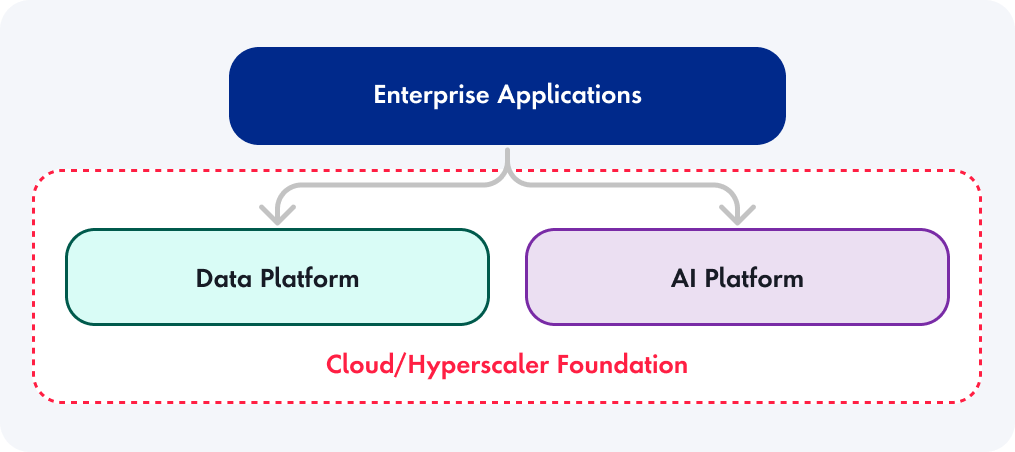
In this model, enterprise applications remain the primary source of functionality and innovation.
Organizations rely heavily on vendor roadmaps and ecosystems to drive future capabilities. This approach often provides faster implementation timelines and lower complexity but may reduce flexibility over time.
2. Data-centric
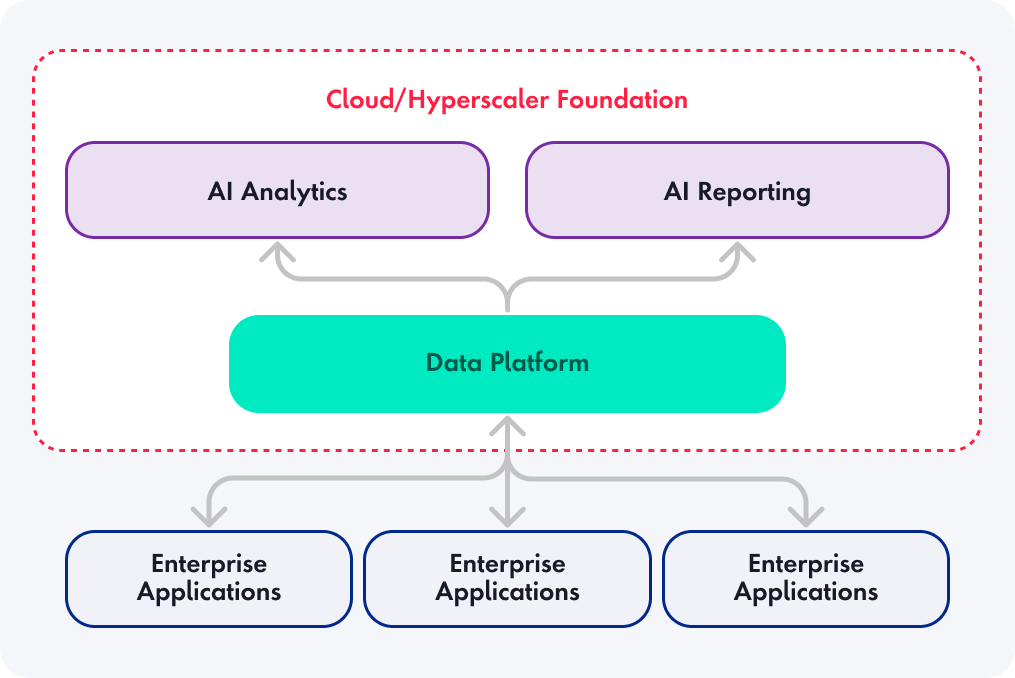
In the data-centric model, the enterprise data platform becomes the strategic hub.
Applications become increasingly interchangeable, while reporting, analytics, visibility, and cross-functional insights are managed through a common enterprise data foundation.
This approach provides greater flexibility and visibility but requires stronger data governance and data management capabilities.
3. AI-centric
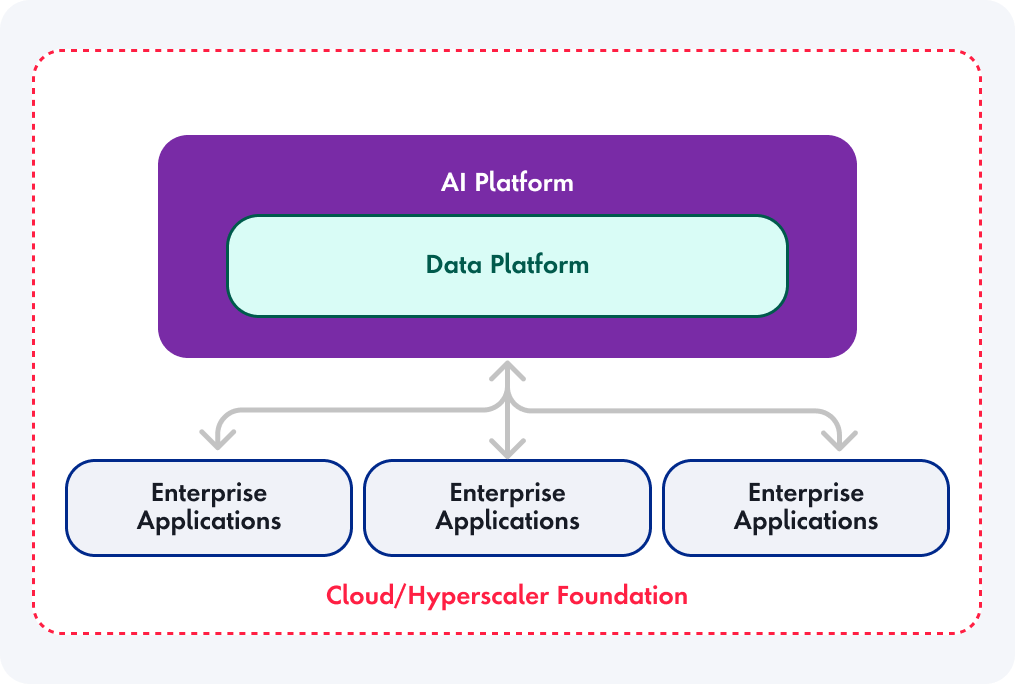
In an AI-centric architecture, AI platforms increasingly orchestrate decisions across the supply chain.
Applications serve as systems of execution. Data platforms provide context. AI coordinates intelligence across the environment.
While still emerging and maturing, this model represents the direction many organizations are exploring as agentic workflows and autonomous decision support continue to advance.
Five decisions every supply chain leader should be making now
Regardless of industry, leadership teams should begin addressing and answering five strategic questions.
-
What will be our long-term system of record?
-
What enterprise data platform will support our business?
-
What is our AI platform strategy?
-
Which cloud ecosystem will anchor our technology investments?
-
Which supply chain capabilities truly create competitive advantage?
Organizations that answer these questions early will be better positioned to capitalize on future innovation. More importantly, they will avoid making disconnected technology investments that create complexity without delivering meaningful business value.
The path forward
Supply chain technology is no longer a software selection exercise. It is an ecosystem design challenge.
Enterprise applications remain essential. Data platforms are becoming enterprise intelligence layers. AI is emerging as a decision layer. Cloud platforms are accelerating innovation. Supply chain leaders must determine how these capabilities work together to support their future-state target operating model.
The organizations making the greatest progress are not starting with technology. They are starting with decisions. They are identifying the critical decisions that drive service, cost, growth, resilience, and profitability. They are determining what information improves those decisions. They are then architecting technology ecosystems that support both.
The question facing supply chain leaders is no longer: Which software should we buy?
The more important question is: What technology ecosystem will enable the supply chain we need to compete in the future?
Organizations that answer that question effectively will not simply modernize their technology landscape. They will improve how decisions are made, how work gets done, and how value is created across the enterprise.